How to Read a Snack Label in 30 Seconds
Ignore the front of the package entirely. Here's the order to check things in, and what actually tells you something.
The front of a package is advertising. The back is regulated. Once you internalize that, label reading gets a lot faster.
Here's the order we check things in, and why. This is the panel we'll be working from — a made-up snack, but every trick in it is one we've seen on a real shelf.
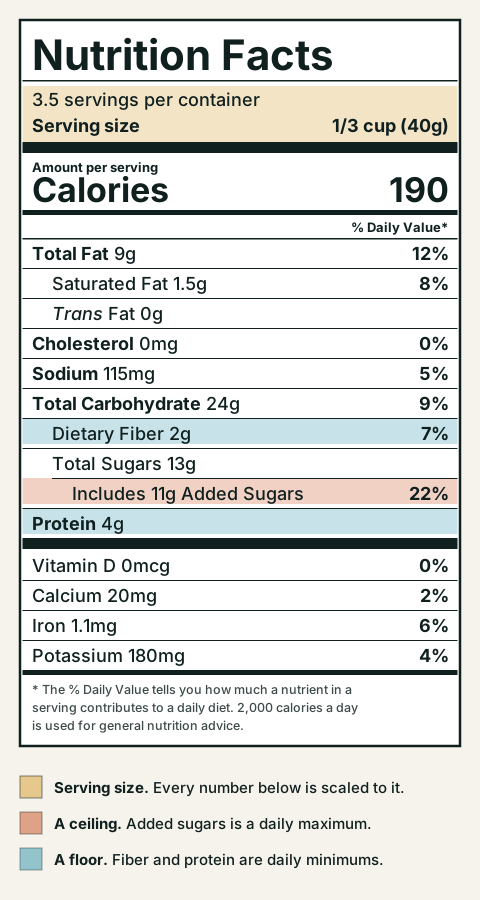
Three colors, and they mean different things. Gold is the number everything else is scaled to. Rust is a ceiling you're trying to stay under. Teal is a floor you're trying to get over. More on why that distinction matters than almost anything else on the panel in a moment.
1. Flip It Over First
Skip the front entirely. "All natural," "wholesome," "made with real fruit," "plant-based," "clean" — none of these are defined terms, and several of them are compatible with a product that is mostly sugar. Start on the back.
2. Serving Size, Before Anything Else
Every number on the panel is scaled to this. Multiply anything on it by the servings-per-container line and the picture usually changes. Manufacturers know that people read the per-serving column, and serving sizes are sometimes chosen accordingly.
Look at the servings-per-container line and ask whether it matches how you'd actually eat the thing. In the panel above, 3.5 servings at 190 calories and 11 grams of added sugar per serving means the bag in your hand holds 665 calories and 38 grams of added sugar. Nobody eats two-sevenths of a bag.
3. The Ingredient List, Read for Length and Order
Ingredients are listed by weight, most to least. Two quick heuristics:
Order. If a sweetener appears in the first three ingredients, you're looking at a sweet product regardless of what the front says.
Sugar aliases. Cane sugar, evaporated cane juice, brown rice syrup, tapioca syrup, agave, honey, coconut sugar, date paste, fruit juice concentrate, maltodextrin, dextrose, and anything ending in "-ose" are all sugars. Splitting one sweetener into several named sugars moves each of them further down the list without changing the total. This is a well-known trick and it's still common.
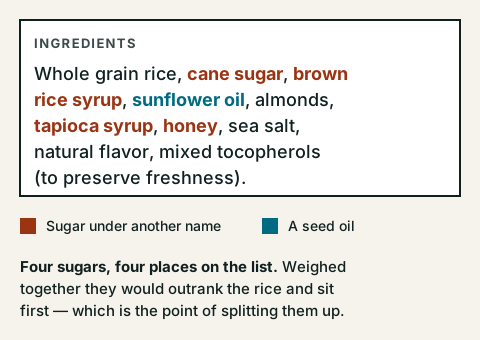
Here's our sample product's ingredient list. No single sugar cracks the top two, which is exactly the impression it's meant to give. Add the four of them together and sugar is the heaviest thing in the bag.
4. Added Sugars
This line was added to the panel relatively recently and it's the single most useful number on it. Total sugars includes sugar that occurs naturally in, say, milk or fruit. Added sugars is what the manufacturer put in. When the two are far apart, that tells you something; when they're identical, that tells you something too.
5. Fiber and Protein — and Which Way You're Trying to Go
These are the numbers that tend to track with a snack being filling. It's not a rule, but a snack with 6 grams of protein and 5 grams of fiber generally behaves differently over the next hour than one with 1 gram of each and the same calories.
But there's something about this panel that nobody explains, and once you see it you can't unsee it.
The %DV column is two different columns wearing the same hat. Every percentage on the right-hand side is measured against a Daily Value, and those Daily Values are not all the same kind of target. Some are ceilings. Some are floors.
- Ceilings — stay under. Added sugars, saturated fat, sodium. The Daily Value for added sugars is 50 grams, and that is a limit, not a goal. A snack at 22% has used up almost a quarter of your day's allowance. Nobody is trying to reach 100% here.
- Floors — try to reach. Fiber, protein, potassium, calcium, iron, the vitamins. The Daily Value for fiber is 28 grams and you are trying to get there. A snack at 7% has contributed a little toward a number you want to hit.
Same column, same percent sign, opposite meaning. A label with 22% added sugars and 7% fiber is not "mostly fine on both" — it's most of the way through a budget you're rationing and barely started on one you're chasing.
There's a small irony in the panel's own design here. Protein is the nutrient most people are actively trying to get more of, and on most labels it carries no percentage at all — look at the sample above. The %DV for protein is voluntary in the US unless the product makes a protein claim, so manufacturers usually leave it blank. The one number you'd most like a benchmark for doesn't come with one, while added sugars — the number you're trying to hold down — always does.
For what it's worth, the protein Daily Value is 50 grams a day, and that is a floor set for the general population rather than a target. If you're older, active, or trying to hold onto muscle, most dietitians would put your number meaningfully higher.
6. About Subtracting Fiber From Carbohydrate
"Net carbs" is everywhere on packaging now, and the arithmetic looks simple: total carbohydrate, minus fiber, minus sugar alcohols. It is worth knowing that "net carbs" is not a term the FDA defines or regulates. It doesn't appear on the panel. The manufacturer does that subtraction themselves, on the front of the box, using rules they chose.
The logic behind it is real. Fiber is carbohydrate your small intestine can't break down into glucose, so it doesn't raise blood sugar the way starch or sugar does. Subtracting it is a reasonable first approximation.
Here's where it stops being straightforward.
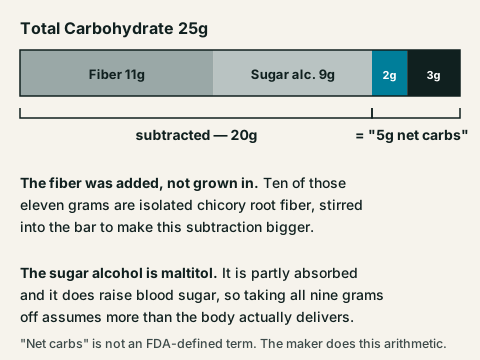
Fiber isn't one substance. Insoluble fiber — the cellulose in vegetables, wheat bran, the skin on an almond — genuinely passes through mostly untouched. Soluble and fermentable fiber is a different story: your gut bacteria ferment it into short-chain fatty acids, which your body does absorb and does use for energy, at roughly 2 calories per gram. Not glucose, not a blood sugar spike, but not nothing either.
Fiber that was added isn't the same as fiber that was already there. The fiber in a handful of almonds is structural — it's part of the almond, it slows down everything else arriving with it. The fiber in a low-carb bar is frequently isolated chicory root inulin, soluble corn fiber, polydextrose or resistant dextrin, stirred in as an ingredient. The FDA permits several of these to be counted as dietary fiber on the panel, so the arithmetic is legal. But a fiber added specifically to enlarge a subtraction is doing a different job than fiber that came with a food, and in quantity these are also a common cause of bloating and worse.
Sugar alcohols get subtracted too, and they're less equivalent than the math implies. Erythritol is largely absorbed and excreted unchanged, so subtracting it is close to fair. Maltitol is partially digested and does raise blood sugar — taking all of it off the total assumes something the body doesn't actually do.
The subtraction is largest exactly where the incentive is largest. A product that goes from 25 grams to 5 by removing 20 has every reason to lean on the most generous possible reading of each rule.
None of this means net carbs are a lie. It means the number is an argument rather than a measurement, and it's most trustworthy when the fiber came attached to a whole food and least trustworthy when it was added by the case. A useful instinct: if a product had to subtract a lot to get to its number, look at what it subtracted.
7. The Fats, Briefly
You're mostly looking for the oil. Soybean, canola, corn, cottonseed, sunflower, and safflower oils are the common industrial seed oils; whether that matters to you is a judgment call and the evidence is genuinely contested. It's worth knowing which oil you're eating either way, and the ingredient list is where you find out.
Also check for partially hydrogenated oils, which are the trans fat source. These have been largely phased out of the US supply, but "largely" is not "entirely."
The 30-Second Version
Serving size → added sugars → first three ingredients → fiber and protein. That's most of the signal, and you can do it standing in the aisle.
It's also a useful exercise to run on things you already buy and assume are fine. That's usually where the surprises are.
This article is general information about reading food labels and is not medical or nutritional advice.
Photo by Rachel Claire on Pexels.
Enjoyed this article? Share it with others:
Stay in the Loop
Get the latest health tips, product updates, and exclusive offers delivered straight to your inbox. No spam, just good stuff.
We respect your privacy. Unsubscribe at any time.
Recommended Reading

Why You're Hungry an Hour After a Protein Bar
It's usually not willpower. It's what most bars are actually made of, and what gets left out.

What "Blood Sugar Friendly" Actually Means on a Label
Short answer: legally, almost nothing. Here's how to read past the phrase to the numbers underneath it.